
Do you know that you can be lying in the same bed with someone and still feel completely alone?
It’s a strange kind of loneliness; not the type that comes when you’re single, but the kind that creeps in when your heart aches for connection in a relationship that feels more like a partnership of convenience than a union of love.
Marriage, in its truest sense, is supposed to be a place of refuge; a home where you feel safe, loved, cherished, and deeply understood.
For many women, their wedding day was the start of a lifelong dream. You picture cozy evenings laughing together, tackling life as a team, raising children with warmth, or simply knowing that when the world feels heavy, you’ll always have one person in your corner.
But sometimes, reality doesn’t always look like the dream you once had. Instead of joy, there’s silence. Instead of warmth, there’s distance. The person you once couldn’t wait to talk to now becomes the person you avoid sitting next to on the couch.
You may even find yourself staring at the ceiling at night, asking quietly: “Is this really it? Is this what marriage is supposed to feel like? Am I in a loveless marriage?” — You’re not alone.
So many women silently battle these questions because admitting it feels heavy. It feels scary. And it feels final.
So, they stay busy with kids, careers, and responsibilities, but deep down, they know something feels off. Love, once vibrant and magnetic, now feels distant… almost invisible.
The truth is, a loveless marriage doesn’t always look like shouting matches or bitter arguments. Sometimes it looks like silence. Sometimes it looks like two people living parallel lives in the same house—connected on paper, disconnected in heart.
And here’s the hardest part: when the love fades slowly, it’s easy to normalize the absence of intimacy. You tell yourself it’s just a phase, just stress, just parenting, just work. Until one day, you realize you don’t remember the last time you truly felt close.
Hey, I’m not writing this blog post to scare you. I’m writing it to help you gain clarity because even strong marriages can hit a stage where the love feels like it’s gone.
And while it’s painful to admit, recognizing the signs of a loveless marriage is the first step toward either rebuilding what’s been lost or finding peace in whatever comes next.
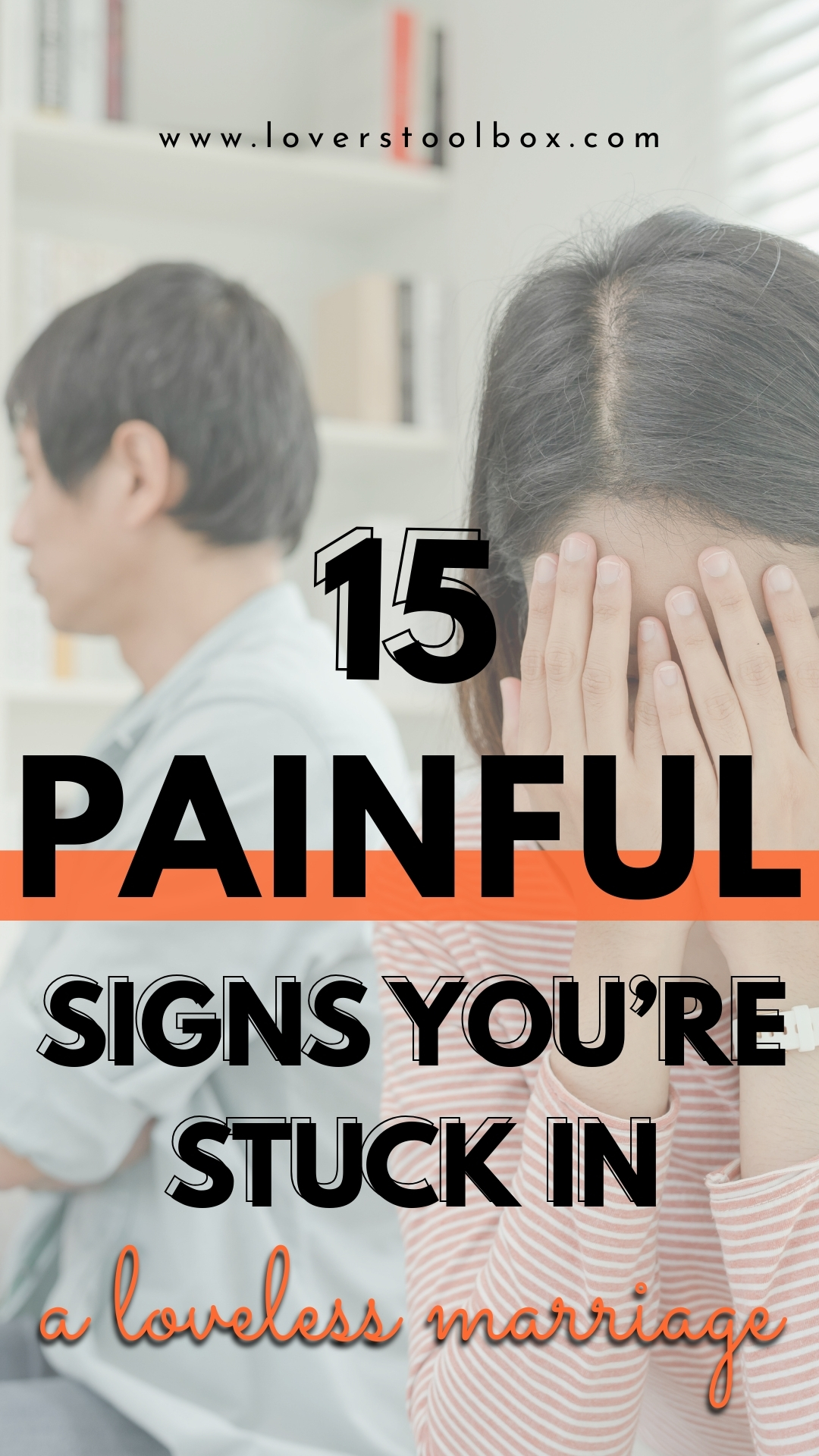
15 Signs You’re in a Loveless Marriage
If you’ve been questioning your marriage, I’ll be sharing 15 clear signs of a loveless marriage; they may be subtle but painful indicators that something deeper may be wrong.
These signs don’t necessarily mean your marriage is doomed, but they do reveal where emotional cracks may have formed. Awareness is the beginning of clarity. And clarity is what you deserve. So, let’s dive in!
1. You Feel More Like Roommates Than Lovers
In the early years, your marriage probably had sparks, stolen kisses in the kitchen, playful touches, long conversations about nothing and everything. But now? You might feel like you’re simply co-managing a household.
You share bills, chores, and maybe even kids… but not intimacy. Days are filled with logistics: “Did you pick up the groceries?” or “Don’t forget the PTA meeting.” Nights end with scrolling on phones or falling asleep on opposite sides of the bed.
Research shows that couples who stop engaging in shared fun or physical affection are more likely to drift into emotional detachment. It doesn’t always happen overnight, oftentimes it’s a slow erosion, until one day you realize: you’re roommates, not partners.
And here’s the heartbreaking part: feeling like roommates doesn’t necessarily come with fights. Sometimes, it’s just quiet. Too quiet. That silence, when it stretches too long, can signal that love has taken a back seat.
2. Affection and Intimacy Have Faded
Affection is more than s*x! It’s the small touches, hugs, kisses, and the warmth of simply reaching for each other without an agenda. In a loveless marriage, these gestures can vanish almost completely.
It starts subtly: you stop kissing goodbye, hugs feel stiff, coitus becomes rare or mechanical. Physical closeness, which used to feel natural, now feels awkward… or worse, nonexistent.
According to the Journal of Social and Personal Relationships, physical affection is one of the strongest predictors of marital satisfaction. Without it, couples often feel rejected, undesired, or simply disconnected.
The absence of intimacy doesn’t just create se#ual frustration. It chips away at self-esteem. You might start asking yourself: “Am I not attractive anymore? Does he not want me?” Those questions cut deep, and when left unanswered, they turn into quiet resentment.
3. Conversations Feel Superficial (or Nonexistent)
Remember when you could talk for hours about dreams, plans, or even silly things that made you laugh? In a loveless marriage, conversations shrink to the bare minimum.
It becomes all about logistics: kids’ schedules, bills, groceries. There’s no depth, no curiosity, no “How are you really doing?” The emotional intimacy that comes from talking openly and feeling heard is gone.
Psychologists call this the “business-only marriage.” You function as co-workers, but not as soulmates. And without meaningful conversation, it’s hard to maintain emotional closeness.
What’s worse? Silence doesn’t always mean peace. Sometimes, silence is avoidance, and it’s easier not to talk than to risk addressing the emptiness you both feel.
4. You No Longer Miss Each Other
One of the most subtle, yet painful, signs of a loveless marriage is realizing you don’t miss your partner when they’re gone.
Think about it: when they travel for work or spend a weekend away, does it feel like relief rather than longing? Do you enjoy the quiet, not because it’s refreshing, but because it means avoiding the emotional strain of being together?
In marriages where love is still alive, even short separations create some kind of emotional pull. You think about each other, send messages, or look forward to reuniting.
In a loveless marriage, absence doesn’t make the heart grow fonder; it just makes space feel easier.
This is often a wake-up call. Because when ‘missing’ someone disappears, it’s usually a sign that emotional attachment has weakened significantly.
5. Resentment Outweighs Gratitude
Every marriage has irritations — forgotten chores, differences in habits, mismatched preferences. But in a loving marriage, gratitude softens those edges. You might feel annoyed, but you also appreciate the good.
In a loveless marriage, however, gratitude evaporates. All you see are flaws. Small annoyances feel huge. You catch yourself replaying old arguments or holding grudges instead of letting them go.
Relationship researchers describe resentment as “emotional rust.” At first, it seems small — just a bit of irritation. But left unchecked, it spreads, eating away at love and respect.
And here’s the catch: resentment doesn’t always look fiery. Sometimes it’s quiet, showing up as sarcasm, passive-aggressive remarks, or a constant low-grade annoyance with everything your partner does.
When gratitude fades, so does tenderness. And without tenderness, love struggles to survive.
6. You Feel Emotionally Unseen or Unheard
Marriage should be the one place where you feel safe to be yourself — messy, complicated, and vulnerable. But in a loveless marriage, that emotional safety disappears.
You share your worries, and they dismiss them. You express excitement, and they barely respond. Or maybe you’ve stopped sharing altogether, because deep down, you know they won’t really listen.
This emotional invisibility is devastating. Humans are wired for connection, and when your spouse doesn’t acknowledge your inner world, it creates a profound sense of isolation.
One of my friend who is a relationship counselor usually say: “Loneliness is not the absence of people. It’s the absence of intimacy.” And nothing feels lonelier than lying next to someone who doesn’t see you anymore.
7. Arguments Don’t Lead to Resolution
Fights are normal. In fact, healthy couples argue, but they also repair. They talk it through, apologize, compromise, and grow from the conflict.
In a loveless marriage, arguments feel different. Either they explode and never get resolved, or they’re avoided altogether. Both patterns are damaging.
If every disagreement ends in stonewalling, blame-shifting, or emotional withdrawal, then arguments stop being about finding solutions and instead become proof of deeper disconnection.
Worse still, some couples stop fighting entirely. At first, that might sound like peace, but often it’s just apathy. When neither partner cares enough to argue, it usually means love has already checked out.
8. You Avoid Each Other Instead of Seeking Comfort Together
In healthy marriages, partners often seek each other out at the end of a hard day — to share frustrations, vent, or simply sit in silence together. But in a loveless marriage, avoidance becomes the norm.
Instead of turning toward each other, one or both spouses begin turning away. You might stay longer at work, spend hours scrolling on your phone, binge-watch shows alone, or even volunteer for activities just to minimize time at home.
This avoidance is less about needing “space” and more about protecting yourself from further disappointment.
According to relationship researcher Dr. John Gottman, emotional withdrawal is one of the strongest predictors of divorce. When couples start living parallel lives, intimacy doesn’t just fade; it withers.
If you notice yourself preferring anyone else’s company but your partner’s, it’s often because the emotional safety you once found in your marriage has disappeared. Avoidance becomes a silent scream for connection, signaling that love and comfort are no longer mutual.
9. No More Shared Goals or Future Dreams
Marriage isn’t just about living together in the present; it’s about building a shared future. Couples who are emotionally connected often talk about plans: vacations, family traditions, financial goals, and even retirement dreams.
In contrast, a loveless marriage feels like a partnership that has lost its direction. You stop saying “we” and start saying “I.”
Perhaps your conversations no longer include joint goals. You make decisions independently because it feels pointless to involve your spouse. Or you might sense they’ve already given up on imagining a future together.
Psychologists emphasize that shared meaning is one of the strongest bonds in marriage. When that evaporates, life together becomes purely functional.
Think of it this way: a marriage without shared goals is like rowing a boat where each partner paddles in opposite directions. You don’t move forward, you just drift apart.
10. Your Partner Feels Like a Roommate, Not a Spouse
One of the clearest signs of a loveless marriage is when the relationship begins to resemble a roommate arrangement. You share bills, chores, maybe even children, but the warmth and romance that once defined your bond have been replaced with routines and obligations.
You might catch yourself introducing your partner with a flat tone or feeling indifferent about whether they’re even home.
Nights are spent in separate corners of the house, and physical closeness feels unnatural. It’s not that conflict is raging; it’s that indifference has taken over.
While many couples go through “roommate phases” during stressful life seasons, in a loveless marriage, this shift becomes permanent. The spark is no longer dormant; it’s extinguished.
And without emotional effort from both sides, the relationship risks becoming a cohabitation rather than a marriage.
11. You Feel Alone, Even When You’re Together
Loneliness within a marriage is perhaps one of the most painful experiences. You can be sitting right next to your partner, yet feel as though you’re on opposite ends of the world.
This emotional isolation stings more than physical separation because it underscores the gap between what you expected marriage to be and what it has become.
Psychologists describe loneliness in marriage as a lack of emotional attunement, where one partner’s needs and feelings consistently go unseen or unmet. If you often think, “I feel more understood by my friends than by my spouse,” it’s a red flag that your marriage might be over.
This loneliness doesn’t always come with shouting or rejection; often, it’s marked by silence. A silence that communicates, “You’re here, but not really with me.”
Over time, this breeds resentment and erodes self-worth. Feeling invisible in the one relationship that should be most intimate is a sign that love is no longer the foundation.
12. Criticism and Contempt Overshadow Respect
Every couple argues, but there’s a difference between disagreements and contempt. In loveless marriages, criticism often becomes constant — nitpicking each other’s flaws, mocking habits, or dismissing opinions with eye-rolls and sarcasm.
When partners start speaking to each other with disdain, they gradually erase the respect and admiration that their relationship needs to thrive.
For example, instead of saying, “I wish you’d help with the dishes,” it becomes, “You never help. You’re so lazy.” The words are sharp, but it’s the underlying contempt that makes them lethal.
If interactions feel more like battles for superiority than opportunities for connection, it’s not just unhealthy conflict; it’s the sign of a loveless marriage where kindness and admiration have been replaced by bitterness.
13. You’ve Stopped Making an Effort for Each Other
At the start of a marriage, effort comes naturally. You plan dates, surprise each other, dress up, and say “thank you” for small acts.
In a loveless marriage, effort fades away. Birthdays are forgotten, compliments disappear, and you stop caring about the little things that make each other feel special.
It’s not about expensive gifts or grand gestures; it’s about consistent emotional investment. Love thrives on effort. When effort vanishes, what remains is apathy.
You might notice your partner no longer tries to make you laugh, or you no longer bother to ask about their day. The absence of effort communicates, “You’re no longer worth the energy.”
And while effort doesn’t guarantee love, the lack of it almost always signals that love has already faded.
14. You Stay Together Only For The Kids, Finances, or Appearances
Sometimes couples remain in loveless marriages not because they want to, but because leaving feels too complicated. Children, financial ties, cultural expectations, or fear of judgment can keep people locked in marriages long after the emotional bond has dissolved.
You might hear yourself saying, “I’m staying for the kids,” or “It’s easier this way.” While these reasons are valid and complex, they also reveal that the foundation of love is no longer present. You’re maintaining the shell of marriage without its soul.
Living this way often comes with heavy emotional costs. Research shows children are more affected by constant parental conflict and coldness than by divorce itself.
Meanwhile, spouses who stay solely for appearances often develop resentment and emotional fatigue. It’s a survival strategy, not a love story.
15. Deep Down, You Know Something Is Missing
Finally, one of the most telling signs of a loveless marriage is your gut instinct. Even if you can’t quite put it into words, you feel the emptiness. You sense the love is gone, not just buried under stress or routine, but truly absent.
Maybe you look at other couples and wonder, “Why don’t we have that anymore?” Or you remember the way things used to feel and realize it’s been years since you’ve experienced that warmth. This quiet recognition often lingers in the background, surfacing during moments of vulnerability.
Your inner voice is powerful. If it’s telling you something’s missing, it’s worth listening. Love doesn’t always vanish overnight, but when it’s gone, pretending otherwise only prolongs the pain.
Final Thoughts On Signs You’re In A Loveless Marriage
Realizing you’re in a loveless marriage is not easy. It challenges your identity, your future plans, and the life you thought you were building. But awareness is also the first step toward change.
Some couples may rediscover love through counseling, intentional effort, and honest communication. Others may choose to part ways to reclaim joy and fulfillment.
What matters most is not ignoring the signs. Because living in a loveless marriage doesn’t just hurt your relationship, it erodes your spirit, your health, and your hope.
If any of these signs resonate with you, know that you are not alone. Millions of people wrestle with the same questions, and many go on to find healing, whether within their marriage or beyond it.
Love is too important to live without. And you deserve to experience it fully, not just in name, but in truth. So, I hope you start living your truth soon! Ciao, until I see you next time…
SAVE THIS PIN FOR LATER

Leave a Reply